With all of the flights booked to and in Europe and all the hotels/apartments booked in Spain I finally feel a sense of relief that it is all coming together.
What a big trip - 6 weeks in Europe visit friends and family and exploring Southern Europe. Thankfully after 5 years of saving points I am able to take Mom and Nelz in business class (which will make travelling that much more smooth and cheaper) - I used 300,000 points just for this.

The trip will explore Spain (with a specific focus on southern Spain with all of the Moorish influence) and of course the delights of Spanish Tapas. A visit also to an old friend in Barcelona - Ruben. Ruben and I met over 12 years ago when he was studying in Vancouver - he is originally from Venezuela and now lives in Barcelona.
We continue our trip with a flight to Venice. Nelson has for many years asked and begged to go to Venice, and so here we are. Apparently he has plans to re-enact "Like a Virgin"the video. Mom has already been to Venice once so she has a good sense already of the stairs and amount of walking involved.

The city stretches across 118 small islands in the marshy
Venetian Lagoon along the
Adriatic Sea in northeast Italy. The saltwater lagoon stretches along the shoreline between the mouths of the
Po (south) and the
Piave (north) Rivers. The
Venetian Republic was a major maritime power during the
Middle Ages and
Renaissance, and a
staging area for the
Crusades and the
Battle of Lepanto, as well as a very important center of commerce (especially
silk,
grain and
spice trade) and
art in the 13th century up to the end of the 17th century.
From Venice we board a cruise ship for a 6 night adventure of the Adriatic and Greece.

Venice (Italy)
Bari (Italy)
Katakolon (Greece)
Santorini (Greece)
Mykonos (Greece)
Rodi (Greece)
At Sea
Dubrovnik (Croatia)
We be departing the ship in Dubrovnik to first explore the old city for the day, and then to travel to the Island of Korcula which is about 22 hours drive north of Dubrovnik.
Dubrovnik is an amazing and romantic place that takes my breath

away. The old walled city is literally paved in marble and polished daily by the thousands of feet that walk in the city. The city is a walled naval fortress from days gone and was a significant naval city in the Adriatic. The city walls are massive and envelope the old city - they are at least 8 feet die and 40 feet high. Areas of it are so wide you could drive a car along the top.
In the
Middle Ages, as the
Republic of Dubrovnik, it became the only eastern Adriatic
city-state to rival
Venice. Supported by its wealth and skilled
diplomacy, the city achieved a remarkable level of development, particularly during the 15th and
16th centuries. Dubrovnik was one of the centres of the development of primarily the
Croatian language and
literature, home to many notable
poets,
playwrights,
painters,
mathematicians,
physicists and other
scholars.
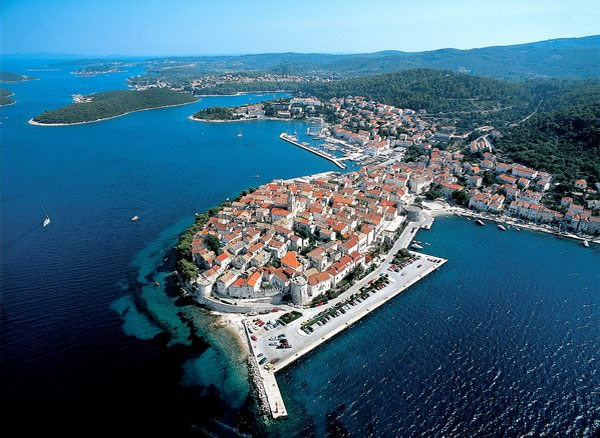
After Dubrovnik we are whisked away to the Island of Korcula. I first saw Korcula 8 years ago when I was living in Zagreb. My friend Kata (from Budapest) and myself went to Korcula for a week. I fell in love with the beauty and the calm of the place. Korcula City is a like a mini-Dubrovnik with a walled city fortress. But Korcula is much more. The economy, besides tourism, is based on agriculture, namely the grape vines, olives and fruit, and fishing and fish processing. The Island is quiet, and while tourism is important, it is not over-run. The smell of dried grasses is in the air and the smell of sizzling squid and seafood is abundant.
But no, our tip does not end. A week later we wake up from a week of bliss on Korcula and fly from Dubrovnik direct to Paris. Our urban sensibilities will be only

awoken for a short time as we explore Paris and then the following day are whisked away on the high-speed TGV train from Paris to Marseilles. TGV (
Train à Grande Vitesse,
French for "high-speed train") is fast Paris to Marseilles in 3 hrs and 18 minutes.
In Marseilles we will be visiting my dear friend Noelle. I have always wanted to go to Provence and in many ways the climate will be similar to Korcula. Drive and fragrant air and the warm winds from the Mediterranean.
Provence has been inhabited since prehistoric times.
Paleolithic sites dating to 900,000 B.C. have been found along the
Côte d'Azur in the interior country above
Nice.
We depart Later that week for Austria for the first of two weekends visiting our relatives who live on the Austian and Hungarian border. My Grandparents on my father's side of the family come from a small village (Klingenbach) about 500 metres from the Hungarian border. The village and my ancestors are all Croatians who migrated (to flee from war - the Ottoman expansion in Europe) over 500 years ago and all live in a series of small villages along the border. They speak Croatian and also German and some Hungarian.

In between our weekends in Austria we will be getting o a train and visiting the fabulous city of Budapest - I am such a fan of this city! The City was originally two cities (Buda and Pest) that fall on either side of the mighty Danube River.
Aquincum, originally a
Celtic settlement,
[9] was the direct ancestor of Budapest,
[10] becoming the
Roman capital of
Lower Pannonia.
[9] Magyars arrived in the territory
[11] in the 9th century. Their first settlement was pillaged by the
Mongols in 1241-42.
[12] The re-established town became one of the centers of
Renaissance humanist culture
[13] in the 15th century.
Widely regarded as one of the most beautiful cities in
Europe,
[1][11][17][18] its extensive
World  Heritage Site
 includes the banks of the Danube, the
Buda Castle Quarter,
Andrássy Avenue,
Heroes' Square and the
Millennium Underground Railway, the second oldest in Europe.
[17][19] Other highlights include a total of 80 geothermal
springs,
[20] the world's largest thermal water cave system,
[21] second largest
synagogue, and third largest
Parliament building.
One of my favourite things to do in Budapest is to visit the Geo-thermal spas that have been in Budapest for centuries. I nice relaxing visit to the spa and sit in mineral water and maybe a

massage to top it off. But don't finish the day without some good cheese, wine and a walk in the city.
After another visit to our relatives and a wonderful goodbye (tear-filled party) with me speaking about my father in Croatian, we depart for our final destination of Prague.
Prague has been the political, cultural, and economic centre of the Czech state for more than
1100 years. The area on which Prague was founded was settled as early as the
Paleolithic age. Around 200 BC
[citation needed] the
Celts had a settlement in the south, called
ZávistI have never been to Prague, but have heard of its beauty and I am ready to explore and discover it.
 The carrot dangling in front of me that gives me the incentive to keep going is the week of relaxation on the island of Korcula. The Island is stunning, calm, the food and wine are fresh, local and yummy. Are rented apartment is on a very quiet little cove and a mere 5 meters to the Adriatic - I will be swimming everyday and that makes me so happy. The water in the Adriatic is so salty that you float in the water with ease. and the colours of the water are beautiful.
